
Search Website
Q&A with Marc Joanisse: Understanding Reading Disorders in Children
BrainsCAN Communications
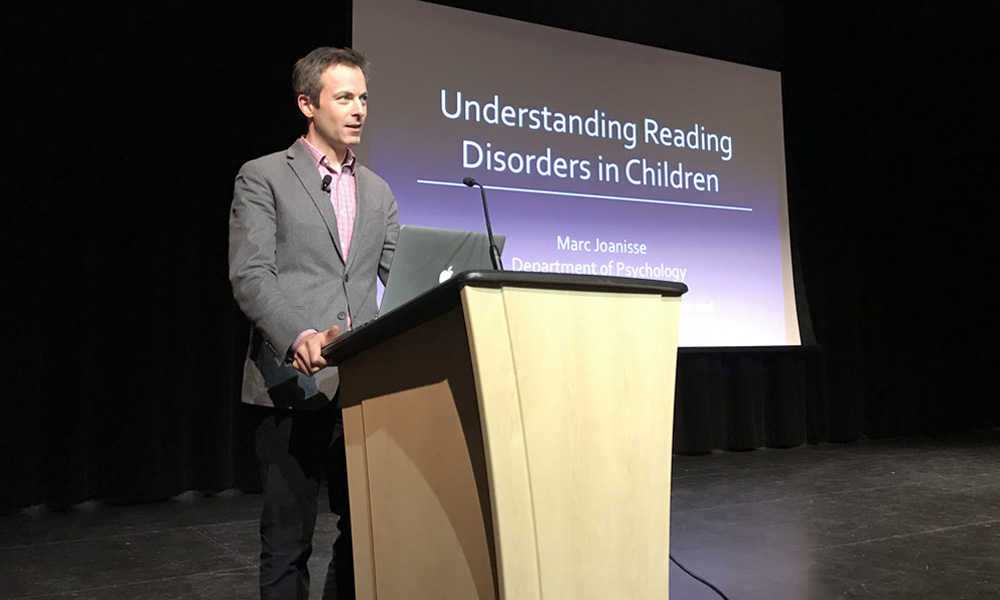
On October 22, Professor Marc Joanisse from the Department of Psychology at Western spoke at the London Central Library on the topic of reading development and reading disorders in children. His work in this area, supported by BrainsCAN, focuses on language acquisition, language processing, computational models and how language is represented in the brain.
In this Q&A, Dr. Joanisse discusses the underlying problems of reading disorders and how they are identified in children.
MJ: Studies show that the decoding approach is the best way to teach children to read. Decoding is sometimes called decomposition or phonics. It explicitly teaches children to associate letters with speech sounds (known as phonemes). This decoding process is important because it allows children to know what sounds go with certain letters. This is true for any word, not just a familiar one, and so decoding is key for helping children read new words.
There is a lot of research that suggests moving towards phonics and phonological awareness-based approaches for young readers has a positive impact for many children. By focusing on a decoding-based reading curriculum, like Ontario has done for the past 20 years, we have seen a big boost in reading scores among children.
MJ: One myth is that reading difficulties are due to low intelligence or laziness. In fact, many children with reading difficulties score in the normal range or higher on cognitive measures such as IQ tests.
Another myth is that having a reading difficulty promotes "divergent thinking" or "creativity". Here again, we see no clear correlation between a reading disability and the tendency to be above average on other kinds of skills. This does not mean all children who are poor readers will fall behind on other abilities as well. However, it does mean that we cannot expect children with reading disabilities to automatically excel in other domains, and we need to provide the help they need with reading so they have the greatest chance of success as they grow older.
A third myth focuses on reversing letters as a way to identify a reading disability. People commonly associate dyslexia with writing or reading words backwards or upside down. Reversing letters, or forgetting which direction to write, is a part of normal development in nearly all children. At some points during reading development, children might forget which way to write or they reverse similar letters like d and b. These are typical patterns of normal development. A child with a reading disability might be more likely to commit these errors later into childhood, although this is not always the case and we should not use these types of errors to identify a reading disability.
MJ: Approaches to reading remediation in children with reading deficits should focus on identifying and improving their specific weaknesses. Reading remediation approaches that are the most effective appear to be phonics- and phonological-awareness based approaches, which try to reinforce phonological and decoding skills in children.
There are many phonics-based remediation programs that have been proven to be effective with children. Some of the most popular are:
Additional Reading Disability Resources
For more information, please click on the links below.
London and area:
Learning Disabilities Association – London Region
Boys & Girls Club of London
London Public Library R.E.A.D. Program
Canada:
Empower Reading
Scottish Rite Learning Centres
International:
Lindamood-Bell
Orton-Gillingham
International Dyslexia Association
Dr. Marc Joanisse is a Professor in the Department of Psychology, a BrainsCAN-aligned researcher, and a Principal Investigator in the Brain and Mind Institute.