
Search Website
Community Engagement
Community Engagement
Community Engagement
Community involvement makes research better
The ultimate goal of medical research is to improve the quality of life for those affected by illness, and people living with these conditions – and their caregivers – can play a vital role in that research.
BrainsCAN Associate Director Ryan Salewski learned this firsthand while collaborating with the Alzheimer Society to understand the impact the organization was having on Ontario residents living with the disease.
When the data came back, it showed the society provided more than $1.3 billion in value through its services, which helped people remain in their homes longer and reduced the number of hospital visits.
More importantly, he says, “This gave me just a glimpse into what people were actually experiencing, and I'm really thankful for that, because I think it's helped me be a better advocate at Western to push the research here to really look at more relevant impacts.”
Tony Adebero, research coordinator for the Canadian Centre for Activity and Aging at Western University, says that ensuring their voices are heard at the start of a research project is key to making the work more relevant.
“Most of the great advice that we get in helping us to design proper research is from the individuals and the community members that we're trying to serve, and with that, you hear the stories, you hear the personal stories, and you can more impactfully design research that is relevant.”
There is often a misconception among academics that the general public and those living with health conditions are not interested in understanding the science behind the research that is ongoing.
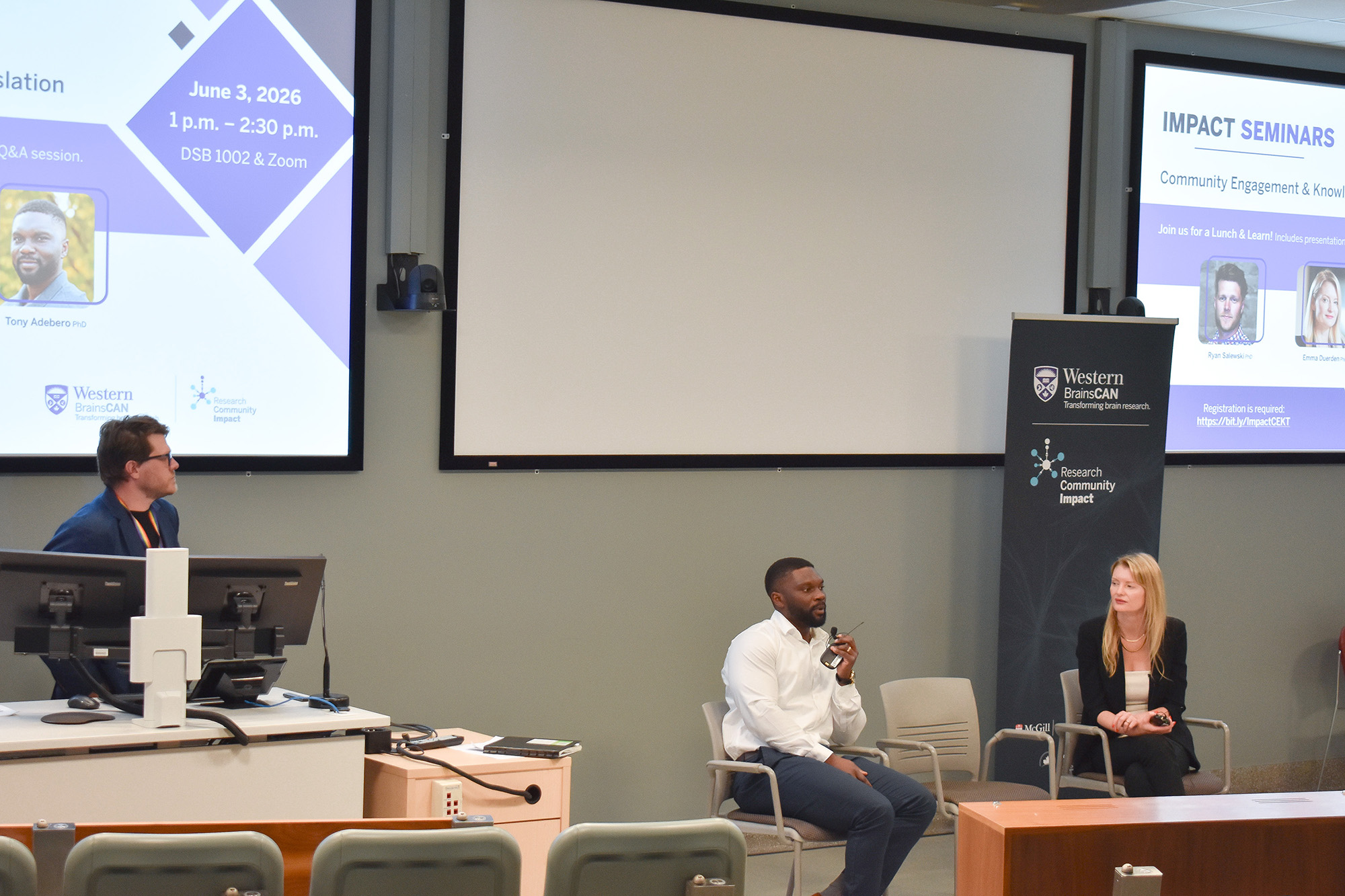
[left to right] Ryan Salewski, Tony Adebero, and Emma Duerden speaking at the seminar
But Emma Duerden, Canada Research Chair in Neuroscience & Learning Disorders at Western University, says she learned early in her career that education and outreach is really valued, both by granting institutions and by the public.
“People want to know about neuroscience, and we had a number of initiatives where we did…like a mini neuroscience school, and we asked faculty to present, and people came in droves to see this. People are very interested to participate.”
While initial outreach can be a challenge – especially if you are looking for individuals impacted by a specific condition to be involved in research – Salewski says with time and the right tools it can work.
“It was not easy, but [the seniors] were so responsive to it, and they were really excited, and the people showed up. They do all that. So, at first, I thought this was going to be a barrier that would be really hard to get over, but actually, there's definitely an appetite out there that people want to hear about what you're doing.”
Duerden adds that the key is to go out into the community and to “know your audience,” communicating with language that is accessible so that everyone can understand your work.
Adebero has had the same positive response from his outreach, finding that many people are more than willing to participate when given the opportunity.
“When you have conversations and you sit down and you're talking and the first thing that comes out of their mouth is, ‘We're always looking for ways to participate in research, we're always looking for ways to engage. We don't really get communication from researchers at the university. No one reaches out to us. How can we participate? How can we get involved?”
Adebero adds that you might have a grand idea for a research study, but once you start listening and start talking to patients and getting their lived experiences, what they think is important might be completely different.
“I think we really need to have more of that,” Duerden adds. “I think that we need to have more forums where we can have that type of community engagement.”
Salewski says people in the community are genuinely interested in the work, ask thoughtful questions, challenge assumptions and want to understand the topic and why it matters.
And besides grounding research in real life and gaining new perspectives that improve the science, he says the conversations can also be beneficial to those participating.
“We've had some fantastic conversations around the research, but then more importantly, these events become catalysts to openly talk about beliefs and fears around aging. We've created spaces where we have conversations that reduce stigma, correct misconceptions, and connect people that have a similar lived experience.”