
Search Website
Equity, Diversity & Inclusion
Equity, Diversity & Inclusion
Equity, Diversity & Inclusion
Strengthening neuroscience research through diversity

Fay Harrison, Executive Director of BrainsCAN
New perspectives are crucial to innovation in science, and BrainsCAN at Western University has been focused on implementing equity, diversity and inclusion (EDI) best practices to encourage research excellence.
"We know that a diverse group of researchers results in better research outcomes, but underrepresented groups often face challenges accessing opportunities because of systematic biases," says Fay Harrison, Executive Director of BrainsCAN. "That's why we've worked to create a more inclusive research environment."
Created in 2021, BrainsCAN's EDI Action Plan was the first-of-its-kind for a Canada First Excellence Fund (CFREF) initiative, supporting diversity in neuroscience by developing initiatives that contribute toward opportunities for historically marginalized groups.
The approach emphasizes transparent and consistent engagement with a focus on developing EDI policies for all, connecting research funding with EDI goals and promoting systemic change.
From 2018 to 2019, Harrison and BrainsCAN Co-Scientific Director Lisa Saksida, Canada Research Chair in Translational Cognitive Neuroscience, worked with the Government of Canada to contribute to the development of a national EDI program to address systemic barriers in post-secondary institutions now called Dimensions Canada.
Building a diverse future

Brooke Gelinas
BrainsCAN has now supported more than 30 undergraduate interns through its Diversity in Neuroscience (DiN) program for students interested in cognitive neuroscience who self-identify as being a member of an underrepresented group including Black people, Indigenous persons, members of racialized groups, members of the 2SLGBTQIA+ community, people with a disability and women.
Brooke Gelinas was a DiN intern for two summers (2022-2023) and says she gained valuable hands-on experience that built her skills and left a mark on her personal and professional growth.

Marieka DeVuono, PhD
"Through their dedication to improving the representation of marginalized groups, BrainsCAN is actively breaking down barriers and providing opportunities for students like me, who self-identify as underrepresented in neuroscience."
After their internships, the majority of DiN students say they intend to pursue graduate studies in a neuroscience related field.
Marieka DeVuono was a DiN student who has since completed her PhD and was awarded a post-doctoral grant with BrainsCAN. She works in the Addiction Research Group in the Department of Anatomy and Cell Biology at Western University.
"Having that kind of support, the financial support obviously, but also the emotional and academic support, and teaching us the hoops you have to jump through in academia when you've never done it before, it's great."
Creating community
BrainsCAN has also partnered with organizations like Western's Schulich School of Medicine & Dentistry to support the student-led IDSTEM (Inspiring Diversity in STEM) biennial conference since 2018.
Originally founded as Inspiring Women in STEM (science, technology, engineering and mathematics), the student-led IDTSTEM conference has aimed to give undergraduate students from diverse backgrounds the opportunity to participate in a research conference.
Avital Sternin, who completed her PhD in neuroscience at Western University and went on to earn her law degree at the University of Toronto, was one of the organizers of the 2018 conference and says it was a great way to help build community.
"It was a way to give back and to ensure the students coming after me would have the same experiences that I did. It was very much to show appreciation for the experiences that I got," she says. "BrainsCAN was very interested in helping us achieve those goals and made it easier."
Flexible and responsive support from BrainsCAN helped relieve the stress of planning a conference and bring in more prestigious speakers, even though organizers had other funding sources.
The conference even led to research projects that were collaborations between post-secondary institutions. A direct academic benefit to the students in attendance.
"Besides the basic idea that you need multiple perspectives to get a good conclusion or to make sure you're capturing all aspects of a problem," says Sternin, "it's really wonderful to see when you have multiple people engaging with the same issue and then working towards making the idea better."
BrainsCAN has also backed Neuroscience Research Day, organized by the Western University Society of Neuroscience Graduate Students and other projects through its Special Initiatives Funding Program.
Improving systemic barriers
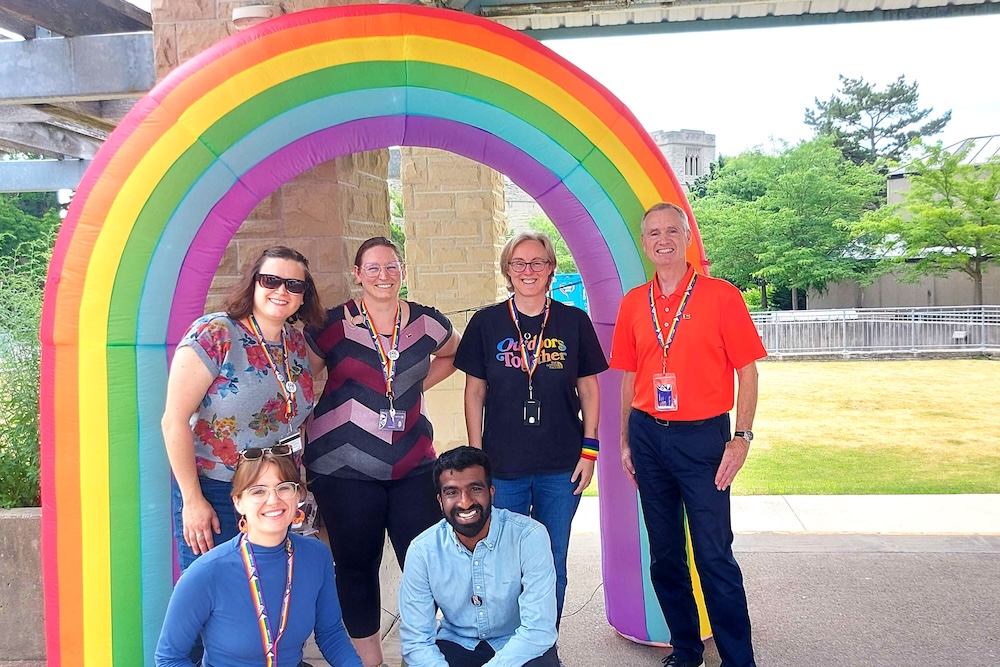
BrainsCAN employees at Western's Pride Parade
BrainsCAN has also implemented a number of measures to mitigate systemic barriers, including:
- Core hours between 9:30 a.m. and 3:30 p.m. for meetings, seminars, etc.
- Inclusive washrooms in BrainsCAN's office spaces
- EDI Resources section on the BrainsCAN website
- Integrated EDI Action plan as a requirement for Accelerator Internal Grant Program applications
- EDI best practices embedded in BrainsCAN Lab Manual template
- EDI webinars, annual surveys and articles